How to Pay Off Debt Fast: 7 Proven Strategies That Actually Work in 2026
Seven strategies to pay off debt faster: debt avalanche, debt snowball, balance transfers, consolidation, side income, automation, and AI tools. Real timelines and examples inside.
Founder of Smart Debt Flow. Building transparent debt management tools with AI coaching and BNPL tracking.
The Framework: Three Variables Control Your Payoff Speed
Before we dive into specific strategies, understand the three variables that determine how fast you get out of debt: principal reduction, interest rate, and time. Principal reduction is the amount of money you put toward paying down your debt above the minimum payment. If your minimum payment is $150 and you pay $350, your principal reduction is $200. This is the lever you control most directly. Every extra dollar you can find goes here. Interest rate is the cost of carrying debt. At 5% APR, you lose money slowly. At 24% APR, you lose money fast. Different strategies prioritize different interest rates. Some target the highest rates first (avalanche method). Some ignore rates and target balance (snowball method). Some target rates through consolidation or transfers. Time is the constraint you cannot escape. The more principal you reduce per month and the lower your interest rate, the faster debt gets paid off. But if you reduce principal by $100 per month, you need 150 months to pay off $15,000. If you reduce principal by $500 per month, you need 30 months. If you reduce principal by $1,000 per month, you need 15 months. The strategies below work by manipulating one or more of these three variables. Some find more money to redirect (increase principal reduction). Some lower your interest rate (consolidation, balance transfer). Some combine both to compress the timeline as aggressively as possible.
Strategy 1: The Debt Avalanche Method
The debt avalanche method is the mathematically optimized approach: pay minimum payments on everything, then throw all extra money at your highest-interest debt first. Once that is paid off, roll its payment into the next-highest-interest debt. Continue until you are debt-free. The advantage of the avalanche: you minimize total interest paid. If you have $5,000 at 24% APR and $5,000 at 6% APR, throwing extra money at the 24% debt saves you approximately $900 over 18 months compared to attacking the 6% debt first. The disadvantage: you may not see a debt fully eliminated for months. If your highest-interest debt is $12,000 and you can only afford $400 per month extra, it will take 30 months to clear that debt and move to the next one. The long slog can hurt motivation. The avalanche method works best when your highest-interest debts are also somewhat manageable in size. If your highest-rate debt is a $500 credit card balance, you can clear it in one or two months, get a win, and move forward. But if your highest-rate debt is a $25,000 balance, you are looking at a long grind. Use the avalanche if you are mathematically driven, have stable income, and respond well to optimizing for total cost rather than psychological wins.
Strategy 2: The Debt Snowball Method
The debt snowball is the psychologically optimized approach: pay minimum payments on everything, then throw all extra money at your smallest debt. Once it is paid off, roll its payment into the next-smallest debt. The advantage: you get fast wins. Clearing your first debt in two to four months feels incredible. That momentum keeps you focused, and your ability to stay consistent matters more than saving $500 in interest over 24 months. Research from Northwestern Kellogg School of Management found that people using the snowball method were 14% more likely to pay off debt consistently because early wins built momentum and belief. The disadvantage: you may pay slightly more in total interest compared to the avalanche method. If your smallest debt is $2,000 at 8% and your largest is $20,000 at 26%, the snowball method means you clear the 8% debt first, "wasting" a few months of extra payments on lower interest. But the difference is usually only a few hundred dollars, not thousands. The snowball method works best when you have struggled with financial commitments before, when you have multiple small debts, or when motivation is your primary challenge. Use the snowball if you respond to momentum and early wins, if you have been trying to get out of debt for years with minimal progress, or if you have a fragile budget with inconsistent income.
Strategy 3: Balance Transfer for Credit Cards
If most of your debt is on high-interest credit cards (20%+ APR), a balance transfer can lower your interest rate to 0% for 6 to 24 months, compressing your payoff timeline dramatically. Here is the math: You have $8,000 in credit card debt at 22% APR. Your minimum payment is $240 per month, of which $147 goes to interest and only $93 goes to principal. At minimum payments, you are looking at 60+ months to pay this off. You transfer that $8,000 to a 0% APR balance transfer card with a 12-month promotional period. There is typically a 2% to 3% transfer fee ($160 to $240), but you just saved $147 per month in interest. Your goal is to pay off $8,000 + $240 transfer fee = $8,240 in 12 months. That requires $686.67 per month, which is $447 per month more than your current minimum payment. Can you find $447 extra per month? This is where the balance transfer strategy lives or dies. If you can, that $8,000 debt is gone in a year instead of five years. You save approximately $6,000 in interest. If you cannot find the extra money, the balance transfer did not help much. The strategy works even better if you already have a balance transfer card open. You avoid hard inquiries and can move debt immediately. The strategy falls apart if you open a new balance transfer card, clear the old debt, then immediately rack up new debt on the old card. Use a balance transfer if: you have $5,000+ in high-interest credit card debt, you have decent credit (670+ FICO), you can find at least $300 extra per month to accelerate payoff, and you have the discipline to not use cleared cards while paying off the balance transfer.
Strategy 4: Debt Consolidation
Debt consolidation rolls multiple debts into a single new loan, usually at a lower interest rate than the average of your existing debts. This works especially well if you have credit card debt at 22% APR mixed with a personal loan at 14% APR. A consolidation loan typically comes in two forms: a personal loan from a bank or online lender, or a home equity loan/line of credit (if you own a home). Personal loan consolidation: You borrow $15,000 at 9% APR, use it to pay off your three credit cards at 20%, 23%, and 18% APR. Now you have one payment instead of three, and your average rate dropped from 20.3% to 9%. Over 36 months, you save approximately $3,200 in interest compared to minimum payments on your original cards. The advantage of consolidation: simplified payments, lower interest rate, fixed payoff timeline. You know exactly when your debt will be gone. The disadvantage: you may extend your timeline. If you currently have five years left on your credit cards but consolidate into a seven-year loan, you pay more total interest despite the lower rate. Consolidation only works if you keep the same payoff timeline or accelerate it. Home equity consolidation: If you own a home, you can take out a HELOC (home equity line of credit) at 7% to 8% APR and use it to pay off $30,000 in credit card and personal debt. The interest savings are substantial. The risk is that you are now secured debt against your home. If you miss payments, the lender can foreclose. Use consolidation if: you have $10,000+ in debt across multiple creditors, your credit score is 680+ (lower scores get worse consolidation rates), your current payoff timeline is longer than you want, and you will not open new accounts on cleared debt.
Strategy 5: Find Extra Income Through Side Hustles
Every strategy discussed so far assumes you have extra money after your minimum payments and living expenses. If you do not, finding extra income becomes critical. A $300 per month side hustle cuts your debt payoff timeline by 40% compared to minimum payments alone. A $500 per month side hustle cuts it by two-thirds. Common side hustles that work for debt payoff: Freelance writing/editing ($25 to $150 per hour). If you have writing skills, platforms like Upwork, Fiverr, and Contently connect you with clients. One article per week can generate $300 to $600 per month. Virtual assistant work ($15 to $35 per hour). If you can manage schedules, email, and administrative tasks, companies on Fancy Hands and Belay Solutions hire remote assistants. Delivery driving ($15 to $25 per hour plus tips). DoorDash, Uber Eats, and Instacart let you work on your schedule. Realistic expectations: $300 to $500 per week working 15 to 20 hours. Selling items online. If you have closet clutter, used phones, or other items, eBay, Facebook Marketplace, and Poshmark let you convert clutter to cash. Realistic: $100 to $500 per month depending on what you have. Tutoring ($20 to $60 per hour). If you have expertise in academic subjects, Chegg, Care.com, and local tutoring centers hire tutors. Freelance services (graphic design, web design, bookkeeping). If you have professional skills, you can charge premium rates. $50 to $200+ per hour is realistic. The key constraint with side hustles: burnout. Working a full-time job plus a 10 to 15 hour per week side hustle is sustainable for 6 to 12 months. Trying to maintain that for 24 months leads to burnout and quitting. Use a side hustle as a temporary accelerator: work the side gig intensely for 6 to 12 months to eliminate your highest-interest debt, then use that freed-up payment to accelerate payoff of the next debt. Do not expect to sustain high side hustle income indefinitely.
Strategy 6: Automate Your Payments to Prevent Slippage
The most underrated strategy for fast debt payoff is automation. Setting up automatic payments removes the friction that causes people to fall back on minimum payments. Here is how slippage works: You intend to pay $400 extra per month on your credit card. Month one, you pay it. Month two, you pay $300 because you had a car repair. Month three, you pay $250 because of an unexpected dentist visit. Month four, you forget and pay minimum only. By month six, you are back to minimum-only payments. The roadmap to fast payoff has collapsed. Automation fixes this through behavioral design. Set up automatic transfers from your checking account to your credit card or lender on the day you get paid. The money never sits in your checking account long enough for you to second-guess spending it. The automation strategy has one requirement: your budget must accommodate the automatic payment without breaking your living expenses. If you automate a $400 extra payment but then overdraw your account because you miscalculated living expenses, you have failed. Test your budget first: what is the maximum extra payment you can sustain every single month for 24 months? That number is your automation amount. For a deeper effect, use a separate savings account as an intermediary. Set up automatic transfer on payday from checking to savings ($500, for example). Once the savings account hits a threshold ($2,000), set up an automatic transfer to your highest-interest debt. This creates a psychological buffer: the money is "saved," which feels less like deprivation than a permanent payment. Use automation as a second-order strategy: pair it with one of the above methods (avalanche, snowball, consolidation). Automation is the execution layer that keeps you consistent.
Strategy 7: Use AI and Data-Driven Tools to Optimize All Strategies
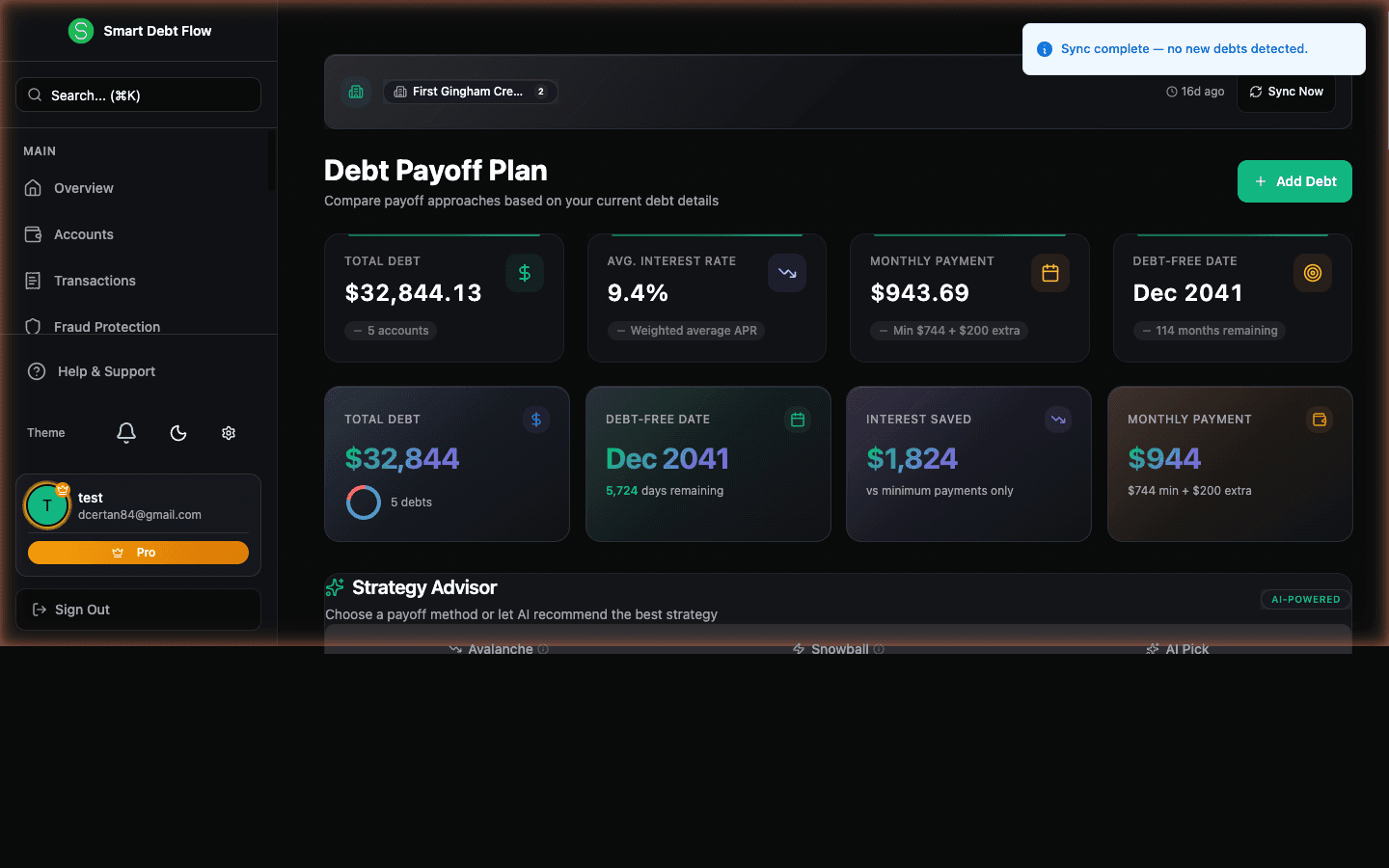
The newest category of debt payoff acceleration is AI-powered optimization. Rather than manually comparing strategies, entering your debts into a tool like Smart Debt Flow runs the math on multiple approaches instantly. Here is what the data-driven approach offers: You enter your debts (balance, interest rate, minimum payment). The tool calculates payoff timelines for avalanche, snowball, balance transfer, and consolidation automatically. You see payoff dates and total interest paid for each scenario. The tool also surface optimization you would not find manually: What if you balance transfer your highest-interest card but keep your second-highest rate on the original card? The tool models this hybrid approach and tells you the payoff timeline and total savings. Additionally, AI tools now optimize for income volatility. If your income fluctuates (you are a freelancer or commission-based salesperson), the tool can model scenarios where you add extra payments some months but not others, calculating your most likely payoff timeline with that variability built in. The Learn & Earn system inside Smart Debt Flow gamifies the payoff process, which adds a behavioral layer to the financial optimization. Paying off debt becomes a game where you level up, earn badges, and battle boss-level debts. Research shows gamification increases consistency by 15% to 20%. Use AI tools in parallel with the strategies above: pick your primary strategy (avalanche, snowball, consolidation), then use the tool to identify secondary optimizations (balance transfer that specific card, find this side hustle amount). The combination is more powerful than either alone.
Putting It Together: The Fast-Track Timeline
Here is a realistic example of combining multiple strategies for maximum speed: Month 1 to 3: Assessment and setup. Enter all debts into Smart Debt Flow. Run the numbers on avalanche, snowball, and consolidation. Identify highest-interest debt (24% credit card, $8,000). Start a consolidation loan application (target 9% APR). Simultaneously, find a side hustle worth $300 to $400 per month. Automate minimum payments on all debts. Month 4 to 9: Acceleration phase. Consolidation loan closes. Use it to pay off the 24% credit card. Immediately redirect the old credit card payment into the consolidation loan (avalanche method targeting remaining highest-interest debt). Side hustle generates $1,800 over six months. Add $300 per month of side income to debt payments via automation. Your total extra payment is now: $150 (freed-up payment from consolidated card) + $300 (side hustle) = $450 extra per month above minimums. Month 10 to 18: Momentum phase. Your highest-interest debt (original 22% card, $5,000) is now down to $2,000. Side hustle income continues. You get your first major debt completely eliminated (the consolidation loan is 40% paid off). Use this psychological win to maintain discipline. Reduce side hustle slightly if it is causing burnout, but keep the automatic $450 extra payment in place. Month 19 to 24: Finish phase. All original high-interest debt is paid off. Remaining debt is lower-interest accounts (car loan at 6%, student loan at 5%). These are being paid on a standard schedule. Your total payoff timeline has compressed from 60+ months (on minimum payments) to 24 months. Total interest saved compared to minimum payments: $8,000 to $12,000. Psychological wins: multiple debt eliminations along the way. Behavioral consistency: automated, so no month-to-month willpower required. This is how you pay off debt fast. It is not one magic strategy. It is the combination of rate optimization (consolidation), prioritization (avalanche), behavioral automation, and income supplementation working together. Smart Debt Flow helps you model all of this before you commit.
RELATED TOPICS
Continue Reading
Ready to Apply What You've Learned?
Use Smart Debt Flow's AI-powered tools to implement these strategies and achieve your financial goals faster.
Disclaimer: This article is for educational purposes only and does not constitute financial advice. Financial strategies should be tailored to individual circumstances. Consult with a certified financial planner or advisor for personalized recommendations.
Last Updated: March 18, 2026