How to Get Out of Debt: The Complete 2026 Guide
Learn how to get out of debt with proven strategies. Updated for 2026 with BNPL tracking, AI coaching tools, and current debt payoff methods to become debt free faster.
Founder of Smart Debt Flow. Building transparent debt management tools with AI coaching and BNPL tracking.
Introduction: The Path to Debt Freedom Starts Here
If you are searching for how to get out of debt, you are not alone. According to the Federal Reserve, American households carry over $17 trillion in total debt, with the average household owing more than $100,000 across mortgages, credit cards, auto loans, and student loans. The weight of debt affects more than your bank account—it impacts your mental health, relationships, career choices, and overall quality of life. Many people feel trapped, making minimum payments month after month while watching interest charges consume their hard-earned money. But here is the truth that debt collectors and credit card companies do not want you to know: getting out of debt is absolutely achievable, regardless of how much you owe. Millions of people have done it before you, and with the right strategy, discipline, and tools, you can join them. This guide will walk you through every step of the process, from understanding exactly what you owe to celebrating your final payment and building lasting financial freedom. The journey to becoming debt free is not just about math—though we will cover plenty of that. It is about changing your relationship with money, understanding what got you into debt in the first place, and building systems that prevent you from ending up here again. Whether you owe $5,000 on credit cards or $150,000 across multiple types of debt, the fundamental principles remain the same. The difference is simply the timeline and the specific tactics you will employ along the way. What makes this guide different from the countless other resources on debt payoff? We focus on actionable, proven strategies that work in the real world, not theoretical advice that sounds good but fails when life happens. We will address the psychological barriers that keep people stuck, the common mistakes that derail progress, and the tools and techniques that actually accelerate your path to freedom. By the end of this guide, you will have a clear, personalized roadmap for eliminating your debt and never looking back.
Step 1: Assess Your Complete Debt Situation
The first step in getting out of debt is understanding exactly what you are dealing with. Many people avoid this step because confronting the numbers feels overwhelming or shameful. But you cannot navigate to a destination without knowing your starting point. Think of this assessment as turning on the lights in a dark room—what you cannot see controls you, but what you can see, you can change. Start by gathering every piece of information about every debt you owe. This includes credit cards, personal loans, auto loans, student loans, medical bills, money owed to family or friends, buy-now-pay-later accounts, and any other obligations. For each debt, record the following: the creditor name, current balance, interest rate (APR), minimum monthly payment, and due date. Create a simple spreadsheet or use a debt tracking tool like Smart Debt Flow to organize this information. Once you have everything in one place, calculate your total debt by adding up all the balances. This number might shock you—and that is okay. For many people, this is the first time they have ever seen the complete picture. The important thing is that you now know exactly what you are working with. Next, calculate your debt-to-income ratio by dividing your total monthly debt payments by your gross monthly income. If your ratio exceeds 36%, you are in a challenging but manageable situation. If it exceeds 50%, you may need to consider more aggressive strategies or professional help. Understanding this ratio helps you set realistic expectations for your payoff timeline. Finally, check your credit reports from all three bureaus—Experian, Equifax, and TransUnion—at AnnualCreditReport.com. Look for accounts you may have forgotten, errors that could be disputed, and opportunities to consolidate or negotiate. Some people discover debts on their reports that they did not know existed, while others find errors that, once corrected, improve their credit score and borrowing options. Common questions people ask at this stage: What if I cannot remember all my debts? Check your credit reports, review bank statements for recurring payments, and search your email for statements from creditors. Should I include my mortgage? For this exercise, yes—include everything. However, mortgage debt is often treated differently in payoff strategies because of its size, low interest rate, and tax benefits. What about debts in collections? Absolutely include these. Collections accounts damage your credit and may still be collectible depending on your state's statute of limitations.
Step 2: Choose Your Debt Payoff Strategy
Once you know what you owe, you need a systematic approach to paying it off. The two most popular and proven strategies are the Debt Snowball and the Debt Avalanche. Both work, but they appeal to different personalities and situations. Understanding the difference will help you choose the approach most likely to carry you to the finish line. The Debt Snowball Method, popularized by Dave Ramsey, focuses on quick psychological wins. You list your debts from smallest balance to largest, regardless of interest rate, and attack the smallest one first while making minimum payments on everything else. When the smallest debt is paid off, you take its payment and add it to the payment on the next-smallest debt. The "snowball" grows larger as you roll payments from eliminated debts into the next target. The advantage of the Snowball is motivation. A 2016 study published in the Journal of Consumer Research found that people who paid off smaller accounts first were significantly more likely to eliminate all their debt. The quick wins create momentum and prove to yourself that progress is possible. The disadvantage is that you may pay more in total interest because you are not prioritizing high-rate debts. The Debt Avalanche Method is the mathematically optimal approach. You list debts from highest interest rate to lowest and focus extra payments on the highest-rate debt first. This minimizes the total interest you pay over your entire payoff journey. If you have a credit card at 24% APR and a student loan at 6%, the Avalanche directs every extra dollar at the credit card. The advantage of the Avalanche is savings—potentially thousands of dollars in interest avoided compared to the Snowball. The disadvantage is psychological: if your highest-rate debt also has a large balance, it may take many months before you experience your first payoff victory. Which should you choose? If motivation is your biggest challenge and you need to see progress quickly, choose the Snowball. If you are disciplined and want to minimize total cost, choose the Avalanche. Some people use a hybrid: pay off one or two small debts first for momentum, then switch to the Avalanche for the rest. Smart Debt Flow can model both strategies with your actual numbers, showing projected payoff dates and total interest for each path so you can make an informed decision. A third option for some borrowers is debt consolidation, which combines multiple debts into a single loan at a lower interest rate. This can simplify payments and reduce interest costs, but it requires qualifying for a new loan and should be paired with a commitment not to accumulate new debt on the cards you pay off.
Step 3: Create a Budget That Actually Works
A debt payoff strategy without a budget is like a car without fuel—you might know where you want to go, but you are not going anywhere. Your budget is the engine that powers your debt elimination plan by ensuring you have money left over each month to put toward extra payments. The key to a budget that works is choosing a system you will actually follow. There are three popular approaches, each with different levels of detail and flexibility: The 50/30/20 Rule divides your after-tax income into three categories: 50% for needs (housing, utilities, groceries, insurance, minimum debt payments), 30% for wants (entertainment, dining out, subscriptions), and 20% for savings and extra debt payments. This framework is simple to follow and provides flexibility within each category. When you are aggressively paying off debt, consider temporarily shifting to 50/20/30—cutting wants to 20% and boosting debt payoff to 30%. Zero-Based Budgeting assigns every dollar a specific job until your income minus all planned spending equals zero. This method is more detailed than the 50/30/20 rule and eliminates the vague "leftover" money that often disappears into impulse purchases. You decide in advance where every dollar goes, including extra debt payments. The challenge is that it requires more upfront work and regular maintenance. The Pay Yourself First method automatically transfers a set amount to savings and debt payments as soon as you get paid, then you live on whatever is left. This approach works well for people who struggle with willpower because the money is moved before you have a chance to spend it. Regardless of which system you choose, the foundation is knowing where your money currently goes. Track every expense for at least 30 days—every coffee, every subscription, every ATM withdrawal. Most people are shocked to discover how much they spend on things they barely remember. A $5 daily coffee habit costs $1,825 per year; redirecting that to debt could pay off a credit card balance. Once you understand your spending, look for easy cuts: unused subscriptions, excessive dining out, premium services you could downgrade, and recurring charges you forgot about. The goal is not to live a joyless existence but to temporarily reallocate money from low-value spending to your high-priority goal of debt freedom. Most people can find $200 to $500 per month without dramatically changing their lifestyle.
Step 4: Increase Your Income
While cutting expenses is essential, there is a limit to how much you can reduce spending without sacrificing basic needs or sanity. Income, on the other hand, has no ceiling. Increasing your earnings—even temporarily—can dramatically accelerate your debt payoff timeline and make the journey feel less restrictive. Start with your current job. When was your last raise? According to PayScale, employees who negotiate their salary earn $7,500 more per year on average than those who do not. Research salaries for your position in your market using sites like Glassdoor, LinkedIn Salary, or the Bureau of Labor Statistics. Document your accomplishments, additional responsibilities, and value you bring to the organization. Schedule a meeting with your manager specifically to discuss compensation, and make your case confidently. If a raise is not immediately available, ask about bonus opportunities, overtime, or additional shifts. Some employers offer referral bonuses for helping recruit new employees. Others have programs that reimburse education expenses, which can reduce your student loan burden. Beyond your primary job, consider side income opportunities. The gig economy has created countless ways to earn extra money on your own schedule: Freelancing in your professional skill area through platforms like Upwork, Fiverr, or Toptal often pays better than traditional side jobs because it leverages expertise you already have. Driving for rideshare services or delivering food and groceries can generate $500 to $1,500 per month working 10 to 20 hours per week, with the flexibility to work whenever suits your schedule. Selling unused items through eBay, Facebook Marketplace, Poshmark, or Craigslist turns clutter into cash that goes directly to debt. Many households have thousands of dollars worth of unused items. Pet sitting, house sitting, or tutoring through apps like Rover, TrustedHousesitters, or Wyzant matches you with local clients for services that require minimal startup costs. Teaching English online to international students through VIPKid or similar platforms pays $15 to $25 per hour and can be done from home during early morning or evening hours. The key is to treat side income as sacred—100% of it goes to debt, not to lifestyle inflation. If you earn an extra $500 this month, make a $500 debt payment the same day you receive the money. This prevents the common trap of earning more but still not making progress because spending rises to match income.
Step 5: Cut Expenses Strategically
Cutting expenses is not about depriving yourself—it is about aligning your spending with your values and priorities. When you decide that debt freedom is more important than another streaming subscription or takeout meal, the sacrifice does not feel like a sacrifice anymore. It feels like an investment in your future. Start with the big three expenses that consume the majority of most budgets: housing, transportation, and food. These categories offer the largest potential savings, even if changes require more effort than canceling a subscription. Housing typically represents 25% to 35% of income. If you are in a high-cost rental, consider moving to a more affordable option when your lease ends. Taking on a roommate can cut costs in half. If you own your home, refinancing to a lower interest rate (if available) or renting out a spare room can reduce this burden. Transportation is the second-largest expense for most families. If you have two car payments, consider whether you could become a one-car household, using public transit, biking, or carpooling for the second driver. Refinancing an auto loan to a lower rate, shopping for cheaper insurance, and reducing driving by combining errands all trim costs. Food expenses are surprisingly flexible. The average American household spends over $700 per month on food, with about half going to restaurants and takeout. Meal planning, cooking at home, using grocery store apps for digital coupons, and batch cooking can easily cut this by $200 to $300 per month without eating nothing but rice and beans. Beyond the big three, conduct a thorough audit of recurring subscriptions and memberships. The average consumer spends $273 per month on subscriptions—many of which they have forgotten about or rarely use. Cancel ruthlessly and resubscribe later if you truly miss something. Negotiate bills you cannot eliminate. Call your cell phone provider, internet company, and insurance carriers to ask for discounts, loyalty rates, or promotions. Many companies offer retention deals to customers who threaten to leave. A 15-minute phone call that saves $30 per month puts $360 per year toward your debt. Finally, implement a waiting period before discretionary purchases. For any non-essential purchase over $50, wait 48 hours before buying. For purchases over $200, wait a week. This simple rule eliminates impulse spending and ensures you only buy things you genuinely want and will use.
Step 6: Negotiate with Your Creditors
Many people do not realize that the terms of their debt are often negotiable. Creditors would rather work with you than send your account to collections or write it off as a loss. A simple phone call can result in lower interest rates, waived fees, modified payment plans, or even settlement offers for less than you owe. Start with your credit card companies. Call the customer service number on the back of your card and ask to speak with someone who can discuss your interest rate. Explain that you are working to pay off your balance and would like a lower rate. If you have been a long-term customer with a history of on-time payments, mention this. If you have received offers from competing cards at lower rates, use that as leverage. Success rates for this call vary, but studies suggest 50% to 80% of people who ask receive some reduction. If you are struggling to make minimum payments, ask about hardship programs. Most major credit card issuers offer programs that temporarily reduce your interest rate to single digits and lower your minimum payment. These programs typically last 6 to 12 months and can provide breathing room while you stabilize your finances. For debts in collections, you have additional negotiation options. Debt collectors often purchase accounts for pennies on the dollar and may accept a settlement significantly below the original balance. Before negotiating, understand that paying a collections account may temporarily lower your credit score, and always get settlement agreements in writing before sending money. Never give a debt collector electronic access to your bank account. For medical debt, contact the hospital or provider billing department before paying. Ask for an itemized bill and review it for errors—medical billing mistakes are extremely common. Request financial assistance applications, which most hospitals are required to offer. Many providers will reduce bills by 20% to 50% for patients who demonstrate financial need, and most will offer interest-free payment plans. Student loan borrowers have their own set of options, including income-driven repayment plans that cap monthly payments at a percentage of discretionary income, and Public Service Loan Forgiveness for those working in qualifying fields. Contact your loan servicer to explore these programs. Document every negotiation: write down the date, time, name of the representative, and exactly what was agreed. Follow up in writing to confirm verbal agreements. This documentation protects you if terms are later disputed.
Step 7: Avoid These Common Debt Payoff Mistakes
The path to debt freedom is littered with pitfalls that have derailed countless well-intentioned people. Learning from others' mistakes can save you months of frustration and thousands of dollars. Here are the most common errors and how to avoid them. Mistake #1: Not having an emergency fund. This might seem counterintuitive—why save money when you have high-interest debt? Because without a small cash cushion, any unexpected expense forces you back onto credit cards. Aim for a starter emergency fund of $1,000 to $2,000 before attacking debt aggressively. This buffer prevents the "two steps forward, one step back" cycle that discourages so many people. Mistake #2: Closing credit cards after paying them off. This damages your credit score by reducing available credit (increasing utilization ratio) and shortening your average account age. Instead, keep paid-off cards open with a zero balance or a small recurring charge that you pay in full each month. Mistake #3: Consolidating without changing behavior. Debt consolidation can be a powerful tool, but it only works if you stop accumulating new debt on the cards you paid off. Otherwise, you end up with both the consolidation loan AND new credit card balances—worse off than before. Cut up the cards or freeze them in ice. Mistake #4: Paying extra on the wrong accounts. Random extra payments spread across multiple accounts have minimal impact. Focus all extra money on one target debt at a time using either the Snowball or Avalanche method. The concentrated attack pays off balances faster, freeing up minimum payments to roll into the next target. Mistake #5: Giving up after a setback. Life happens. You will have months where unexpected expenses eat into your debt payments. You might slip and use a credit card for something you should not have. This does not mean you have failed—it means you are human. Acknowledge the setback, learn from it, and get back on track the next month. Progress is not always linear, but consistent effort over time will get you to your goal. Mistake #6: Not automating payments. Relying on willpower and memory to make extra payments every month is a recipe for missed opportunities. Set up automatic transfers to your target debt on payday, before you have a chance to spend the money elsewhere. Mistake #7: Taking on new debt while paying off old debt. This seems obvious, but lifestyle creep is real. As your minimum payments decrease, resist the temptation to buy a new car, upgrade your apartment, or finance furniture. Stay focused until you reach your debt-free goal.
Step 8: Use Tools to Accelerate Your Payoff
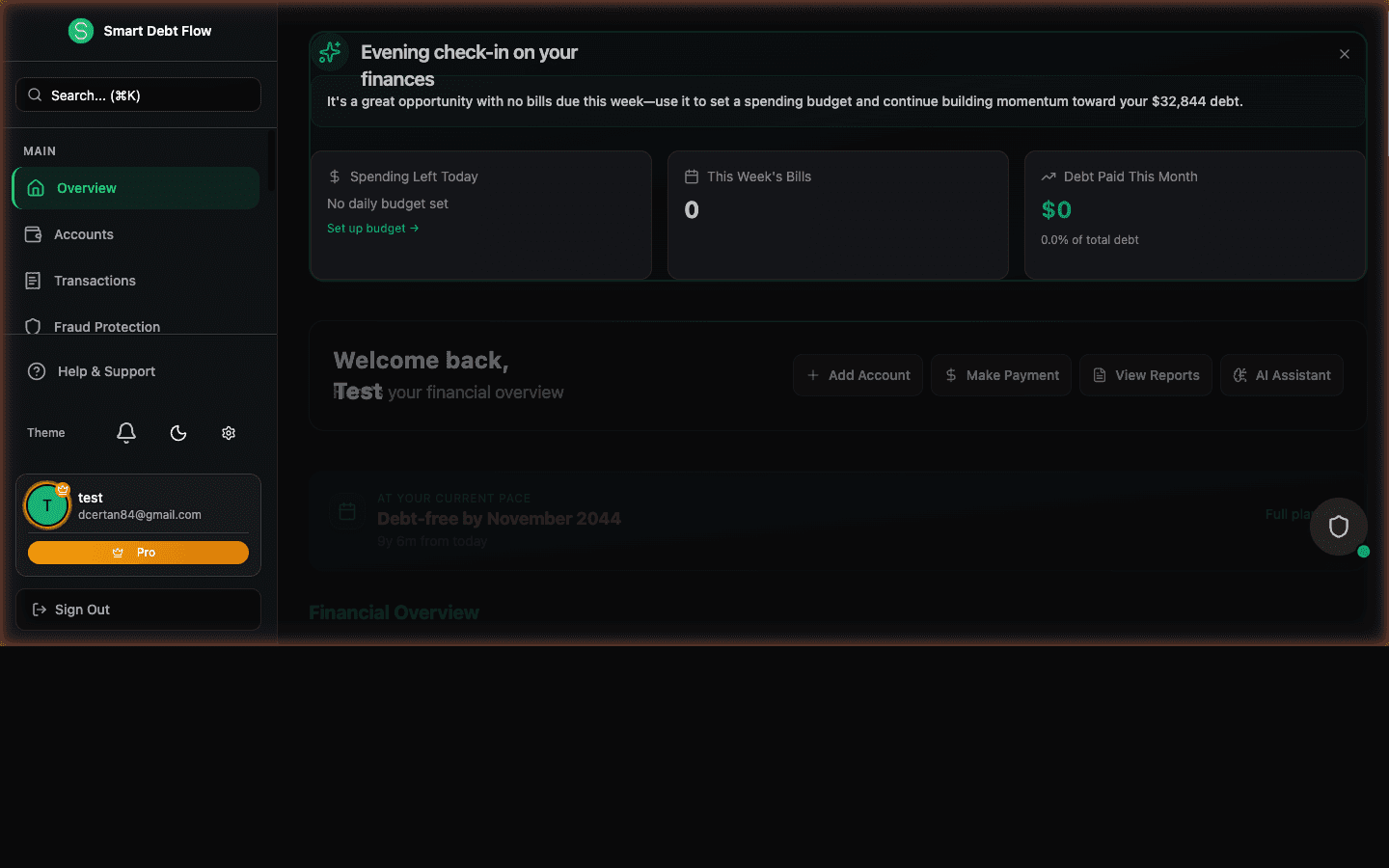
The right tools can make the difference between a debt payoff plan that succeeds and one that fizzles out after a few months. Technology has made it easier than ever to track progress, stay motivated, and optimize your strategy. Debt tracking and planning tools like Smart Debt Flow provide a centralized dashboard where you can see all your debts, their balances, interest rates, and projected payoff dates in one place. The platform can model different payoff scenarios—showing how much faster you would become debt free by adding an extra $100 or $500 per month, or comparing the total interest paid under Snowball versus Avalanche strategies. Having real numbers makes the choice concrete rather than abstract. Smart Debt Flow also connects to your bank accounts through Plaid, automatically categorizing transactions and identifying spending patterns. The AI-powered insights can flag opportunities you might miss: a subscription you forgot about, a spending category that spiked last month, or a debt that would benefit from refinancing. This automation eliminates hours of manual tracking and keeps your budget current without constant effort. The gamification features—earning points for achievements like consecutive payment days, celebrating milestones, and tracking streaks—address the psychological side of debt payoff. Making progress visible and rewarding keeps you engaged during the long middle months when the initial excitement has faded but the finish line is not yet in sight. Beyond dedicated debt tools, consider these complementary resources: Budgeting apps to track day-to-day spending and ensure you stay within categories that fund your debt payments. Balance transfer cards with 0% introductory APR to reduce interest costs if you can pay off the balance within the promotional period. High-yield savings accounts for your emergency fund, earning 4% to 5% APY instead of the 0.01% offered by traditional banks. Side income platforms to generate extra money that goes directly to debt. Credit monitoring services to track your score improvements as you pay down balances—a tangible reward for your efforts. The best tools are the ones you will actually use consistently. Experiment with different apps and platforms to find the combination that fits your workflow and keeps you engaged.
Step 9: Stay Motivated for the Long Haul
Depending on how much you owe, becoming debt free could take months or years. Maintaining motivation over such a long timeline is perhaps the biggest challenge—and the least discussed. Understanding the psychology of debt payoff can help you push through when progress feels slow. First, make your progress visible. Create a debt payoff chart on paper or your wall where you can physically mark each payment. Watching a visual thermometer fill up or a paper chain grow shorter provides tangible evidence that your sacrifices are working. Smart Debt Flow's dashboard serves the same purpose digitally, showing your declining balances and shrinking debt-free date. Second, celebrate milestones appropriately. When you pay off an individual debt, acknowledge the achievement. This does not mean going on a shopping spree—that would undo your work—but a special meal, an experience, or even just a moment of genuine pride reinforces the behavior and builds momentum for the next target. Small celebrations along the way prevent the feeling that you are constantly depriving yourself. Third, connect with your "why." Make a list of everything you will do, be, or have when you are debt free. Maybe it is the freedom to change careers, travel, save for your children's education, retire early, or simply sleep without financial anxiety. Review this list when motivation wanes. Debt payoff is not just about eliminating a number—it is about creating the life you want. Fourth, find an accountability partner or community. Studies show that sharing goals with others increases the likelihood of achieving them. This could be a spouse, friend, online community, or financial coach. Having someone to check in with, celebrate wins, and discuss challenges keeps you engaged when going it alone feels isolating. Fifth, protect your mental health. Financial stress can contribute to anxiety, depression, and relationship strain. If the burden feels overwhelming, seek support from a therapist, counselor, or financial advisor. Taking care of your mental health is not separate from your debt payoff journey—it is part of it. Finally, remember that consistency beats intensity. A sustainable $300 extra payment every month for two years beats an aggressive $800 for three months followed by burnout. Build habits you can maintain, even during hard months, and trust that small actions compound over time.
Step 10: Life After Debt—Building Lasting Financial Freedom
Imagine making your final debt payment. The account shows a zero balance. You are free. This moment, which may have seemed impossible when you started, is absolutely achievable. But becoming debt free is not the end of your financial journey—it is a new beginning. Your first priority after eliminating high-interest debt is building a fully funded emergency fund of three to six months of expenses. This cushion protects against the unexpected—job loss, medical emergencies, major repairs—without forcing you back into debt. Keep this fund in a high-yield savings account, separate from your regular checking, where it is accessible but not too easy to spend. Next, shift the money you were putting toward debt into investments for your future. If your employer offers a 401(k) match, contribute at least enough to capture the full match—it is an immediate 50% to 100% return on your money. Beyond that, fund a Roth IRA up to the annual limit. Automate these contributions just as you automated your debt payments so they happen without requiring willpower each month. The budgeting discipline you built during debt payoff becomes the foundation for building wealth. Continue tracking spending, living below your means, and avoiding lifestyle inflation. The behaviors that got you out of debt are the same behaviors that build financial independence. Learn from this experience to ensure you never end up here again. What led to your debt in the first place? Overspending? Lack of emergency fund? A job loss? Medical crisis? Understanding the root cause helps you build defenses. If emotional spending was a factor, develop healthier coping mechanisms. If lack of awareness was the issue, commit to ongoing financial education. If you do use credit cards going forward, use them as a tool, not a crutch. Pay the full balance every month without exception. Set up autopay for the statement balance, and only charge what you can cover with money already in your checking account. Finally, consider giving back. Share what you learned with others struggling with debt. Your story could inspire someone who is currently feeling hopeless. You have proven that getting out of debt is possible—now you can help light the path for others. Debt freedom is not just the absence of payments. It is the presence of choices. You can take a lower-paying job you love because you do not need every dollar to service debt. You can handle emergencies without panic. You can sleep peacefully without the weight of financial stress. This freedom is within your reach, starting today, with the first step of your plan.
Frequently Asked Questions About Getting Out of Debt
How long does it take to get out of debt? The timeline depends on how much you owe, your income, how much you can dedicate to extra payments, and your chosen strategy. Someone with $10,000 in credit card debt adding $500 per month to minimum payments could be debt free in under two years. Someone with $100,000 across multiple loans might need five to seven years. Use a debt calculator or Smart Debt Flow to model your specific situation. What is the fastest way to pay off debt? The fastest way combines multiple tactics: use the Debt Avalanche method to minimize interest, cut expenses to free up extra money, increase income through side work, and put every windfall (tax refunds, bonuses, gifts) directly toward debt. Some people take extreme measures like moving to lower-cost housing or selling vehicles, which can accelerate timelines dramatically. Should I save money while paying off debt? Yes—at minimum, build a starter emergency fund of $1,000 to $2,000 to handle unexpected expenses without going back into debt. Beyond that, prioritize high-interest debt (anything above 7% to 8%) before investing, as the guaranteed "return" of eliminating debt often exceeds stock market averages. Continue contributing to a 401(k) if your employer offers a match. Is debt consolidation a good idea? Debt consolidation can simplify payments and reduce interest costs if you qualify for a lower rate than your current debts. However, it only works if you stop accumulating new debt on the cards you pay off. Consolidation restructures the problem; a budget and behavioral change solve it. Will paying off debt improve my credit score? Generally, yes. Paying down credit card balances reduces your credit utilization ratio, which can significantly boost your score. However, closing paid-off accounts can hurt your score by reducing available credit and shortening account age. Keep old accounts open with zero or minimal balances. What if I cannot afford my minimum payments? Contact your creditors immediately to discuss hardship programs that may reduce your rate and payment. For federal student loans, explore income-driven repayment plans. If your debt is truly unmanageable, consult a nonprofit credit counselor or consider bankruptcy as a last resort—it is a legal tool designed for situations where debts cannot realistically be repaid. How can Smart Debt Flow help me get out of debt? Smart Debt Flow provides a centralized dashboard for tracking all your debts, models Snowball and Avalanche strategies with your specific numbers, connects to your bank accounts for automated transaction tracking, identifies spending patterns and savings opportunities through AI-powered insights, and keeps you motivated with progress visualization and achievement tracking. It turns the principles in this guide into an actionable, personalized system.
RELATED TOPICS
Continue Reading
Ready to Apply What You've Learned?
Use Smart Debt Flow's AI-powered tools to implement these strategies and achieve your financial goals faster.
Disclaimer: This article is for educational purposes only and does not constitute financial advice. Financial strategies should be tailored to individual circumstances. Consult with a certified financial planner or advisor for personalized recommendations.
Last Updated: March 21, 2026