Debt Snowball vs Avalanche: The Definitive 2026 Comparison (With Calculator)
Debt snowball vs avalanche: we break down both strategies with real math, psychology, and side-by-side examples. Find out which one will get you debt-free faster based on your situation.
Founder of Smart Debt Flow. Building transparent debt management tools with AI coaching and BNPL tracking.
The Two Roads to Debt Freedom
There are two main strategies for paying off debt faster than minimum payments. Both work. Both have built a community of success stories. And both can get you out of debt faster than you think. But they work in fundamentally different ways, and choosing the right one for your situation can save you thousands of dollars—or cost you the same. This is not a debate about which strategy is "correct." It is a practical comparison: if you have $15,000 in debt across multiple accounts, which approach saves you the most money while keeping you motivated? If you have $3,000 in debt, does the math even matter? What if you have kids, unexpected expenses, and a budget you are barely holding together? We will walk through both strategies with real numbers, explain the psychology behind why each one works for different people, and show you exactly how to calculate your own results. By the end, you will know not just which strategy is "better" in theory, but which one is better for you.
What Is the Debt Snowball Method?
The debt snowball method is simple: pay off your smallest debts first, then use the freed-up money to attack the next smallest, and so on. As each debt is eliminated, you have more money to throw at the next one, and momentum builds—like a rolling snowball that gets bigger and bigger. Here is how it works in practice. Let us say you have four debts: Credit card one: $2,100 at 18% APR, minimum payment $63 Credit card two: $4,500 at 22% APR, minimum payment $135 Personal loan: $8,000 at 11% APR, minimum payment $240 Car loan: $12,400 at 6% APR, minimum payment $285 With the snowball method, you list these by balance size, smallest to largest. You make minimum payments on all of them, then throw every extra dollar at the smallest one: the $2,100 credit card. The moment that card hits zero, you stop paying $63 on it and redirect that $63 to the next smallest debt. This is the core appeal: you get wins early. In many cases, you can eliminate your first debt in two to four months. That first victory is psychologically powerful, especially if you have been drowning in debt for years. The snowball method ignores interest rates entirely. It does not care if your smallest debt has 8% interest and your largest has 28%. The order is determined purely by balance.
What Is the Debt Avalanche Method?
The debt avalanche method is the mathematically optimized approach: pay off your highest-interest debts first, then move to the next highest, and so on. Instead of chasing balance size, you are chasing the interest rate. Using the same four debts from above, the avalanche method reorders them by interest rate: Credit card two: $4,500 at 22% APR (highest interest) — attack this first Credit card one: $2,100 at 18% APR — second Personal loan: $8,000 at 11% APR — third Car loan: $12,400 at 6% APR (lowest interest) — last With the avalanche method, you would make minimum payments on all debts, then throw every extra dollar at the $4,500 credit card at 22% APR, even though it is not the smallest balance. The logic is simple: every dollar you pay toward high-interest debt saves you more money in future interest than a dollar paid toward low-interest debt. When that $4,500 card is paid off, you redirect its minimum payment to the next-highest-rate card, and so on. You end the process with the low-interest car loan, which you are basically managing passively while crushing the expensive debt. The avalanche method prioritizes math and total interest paid over psychological wins and early momentum.
The Real Math: How Much Money Do You Actually Save?
This is where the rubber meets the road. Let us run a real comparison using actual numbers. Scenario: You have $15,000 in total debt across three accounts, and you can afford to put $500 per month toward extra payments on top of your minimum payments. Debt One: $3,000 at 18% APR, minimum payment $90 Debt Two: $5,000 at 22% APR, minimum payment $150 Debt Three: $7,000 at 8% APR, minimum payment $140 Total minimum payments: $380 per month Extra payment available: $500 per month SNOWBALL METHOD (smallest to largest): Attack Debt One first ($3,000 at 18%). Extra payment: $500 per month. Time to payoff: 6 months. Attack Debt Two next ($5,000 at 22%). Extra payment: $500 + $90 = $590 per month. Time to payoff: 9 months. Attack Debt Three last ($7,000 at 8%). Extra payment: $590 + $150 = $740 per month. Time to payoff: 11 months. Total payoff time: 26 months Total interest paid: approximately $1,320 First debt eliminated: month 6 (psychological win) AVALANCHE METHOD (highest interest first): Attack Debt Two first ($5,000 at 22% APR). Extra payment: $500 per month. Time to payoff: 10 months. Attack Debt One next ($3,000 at 18%). Extra payment: $500 + $150 = $650 per month. Time to payoff: 5 months. Attack Debt Three last ($7,000 at 8%). Extra payment: $650 + $90 = $740 per month. Time to payoff: 10 months. Total payoff time: 25 months Total interest paid: approximately $980 First debt eliminated: month 10 The difference: The avalanche method saves you $340 in interest over the same time period and gets you debt-free one month faster. But you do not get a single debt cleared for ten months instead of six. This is the real tension. The avalanche method saves approximately 3% to 8% in total interest depending on your specific balances and rates. That sounds small, and in many cases it is. But on $100,000 in debt at an average rate of 18%, that difference could be $3,000 to $8,000. On smaller balances, the difference narrows to hundreds of dollars. The snowball method costs you a bit more in interest but gets you moving faster. A study from Northwestern Kellogg School of Management found that people using the snowball method were 14% more likely to pay off debt consistently than those using the avalanche method, because the early wins kept them committed. That psychological advantage can outweigh the interest savings.
Which One Is Right for Your Situation?
The honest answer is: it depends on you, not on the math. Use the debt snowball if: You have carried debt for years and need an early win to believe change is possible. You have struggled with motivation and consistency on financial goals. Your total debt is under $10,000, making the interest savings difference smaller. You have multiple debts and clearing just one will free up meaningful breathing room in your budget. You are using debt payoff as a confidence-building exercise for a larger financial overhaul. Use the debt avalanche if: You have strong discipline and motivation, and the promise of maximum savings keeps you focused. Your highest-interest debt is significantly higher than the others (think 26% credit card next to 8% personal loan). Your total debt is large, making interest savings meaningful ($100,000 or more). You are willing to delay the first payoff win to minimize your total cost. You respond better to seeing the math and optimization than to seeing rapid debt elimination. Use the hybrid approach if: You have one extremely high-interest debt (27%+ credit card) and several lower-interest accounts. You can attack the highest-interest card first, clear it in 3 to 5 months, then switch to the snowball for psychological momentum. You want early wins and long-term optimization. A critical variable most guides ignore: your cash flow stability. If you have a fragile budget and unexpected $500 expenses appear every quarter, the snowball method is psychologically healthier. You need fast wins to stay in the game. If your income is stable and predictable, the avalanche method is mathematically superior. Another factor: are you borrowing more while you pay off? If you are still carrying high-interest credit cards and still using them, neither method will work until you change the borrowing behavior. The best payoff strategy in the world cannot outrun a spending problem.
Why Smart Debt Flow Helps You Choose
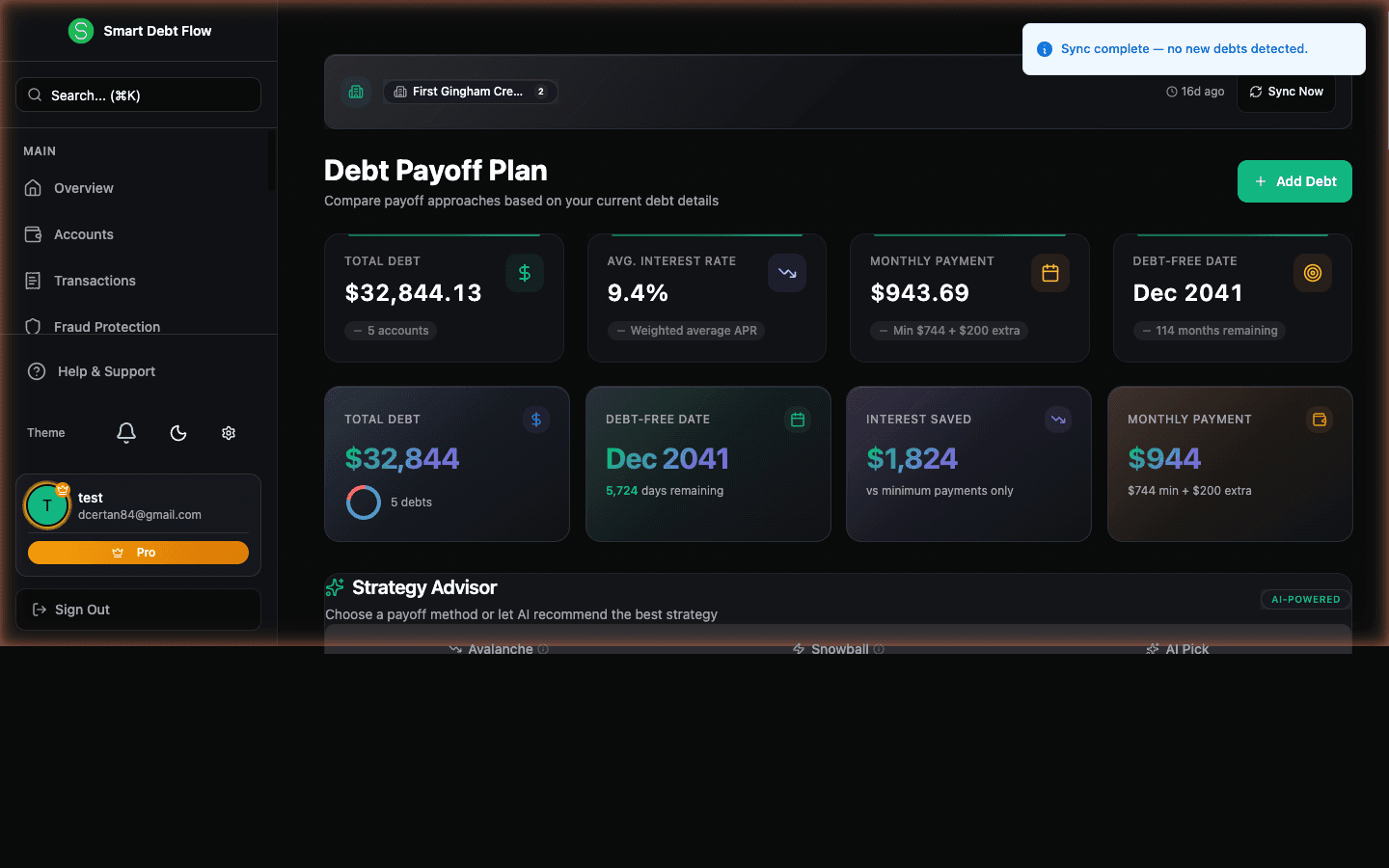
When you enter your debts into Smart Debt Flow, the platform runs the math on both strategies instantly. You see side-by-side comparisons: total interest paid, payoff timeline, and which debts get paid off at which months. You can visualize the difference before you commit. Most importantly, Smart Debt Flow lets you test sensitivity: what if you can put in extra $200 instead of $500? What if you get a bonus at work and can throw an extra $1,000 at debt for one month? The calculator updates instantly, showing you how each scenario plays out under both strategies. The platform also tracks your progress against your chosen strategy. If you are using the snowball method, you get visual rewards as each debt is eliminated—bars filling up, debts crossing off the list. If you are using the avalanche method, the dashboard shows you the interest savings accumulating. You chose the strategy that works best for you, and the platform reinforces it daily. The Learn & Earn boss battle system gamifies whichever strategy you choose. Each debt is a "boss" with a health bar. As you make payments, the boss's HP drops. When the debt is fully paid, you defeat the boss and level up. The psychology is identical to the snowball method—giving you that win—but it works for both strategies. Try Smart Debt Flow's free calculator to compare your own debts under both methods. Enter your balances, interest rates, and available monthly payment, and see exactly how much interest you save and how many months it takes. No algorithm is smarter than understanding your specific numbers.
RELATED TOPICS
Continue Reading
Ready to Apply What You've Learned?
Use Smart Debt Flow's AI-powered tools to implement these strategies and achieve your financial goals faster.
Disclaimer: This article is for educational purposes only and does not constitute financial advice. Financial strategies should be tailored to individual circumstances. Consult with a certified financial planner or advisor for personalized recommendations.
Last Updated: March 21, 2026